

The Real Reason Societies Fall Apart Isn’t Politics or Morals, Author Presents Shocking Evidence
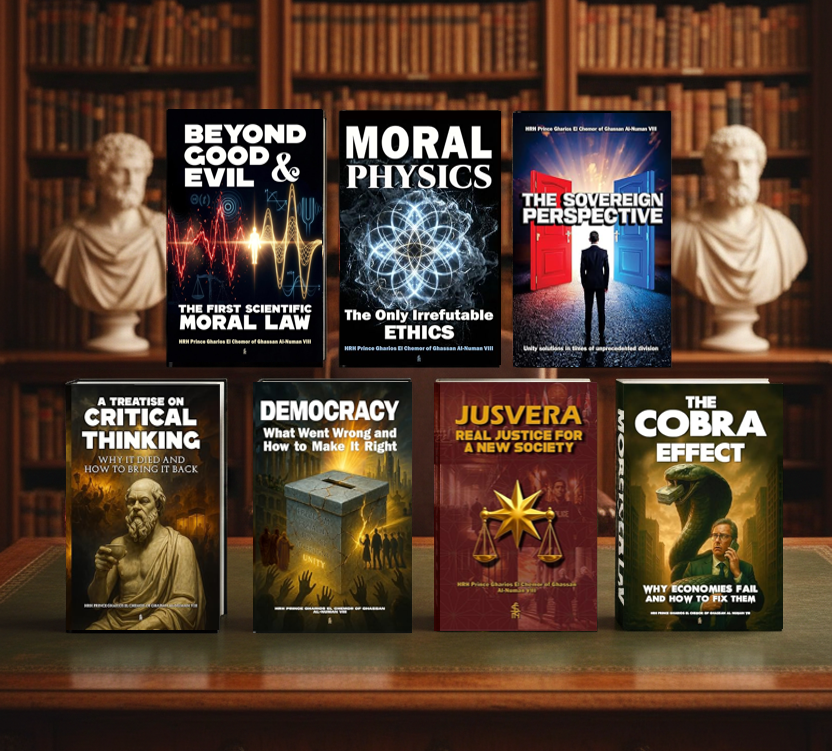
Book Series

HRH Prince Gharios El Chemor
Why societies fall apart isn’t politics or morals, an author argues—it’s cognitive failure, a pattern he says can be scientifically tested.
According to El Chemor, societies do not fail primarily because of bad politics, opposing ideologies, or even the presence of evil. They fail, he says, when poor judgment becomes systemic — allowing harmful forces to grow unchecked.
“Evil has always existed,” El Chemor explains. “What changes throughout history is how much power it’s given. Evil doesn’t dominate societies by intelligence or strength — it dominates them when stupidity enables it.”
By "stupidity", El Chemor is careful to clarify, he does not mean lack of education or intelligence. Rather, he defines it as the collapse of judgment — the inability of individuals and institutions to accept facts, expertise, recognize consequences, integrate reality, and correct course.
A Pattern, Not an Opinion
What distinguishes El Chemor’s claim from political commentary is its scope. He argues that this dynamic appears repeatedly across civilizations with radically different cultures, religions, and moral systems, suggesting a structural pattern rather than a cultural one.
The evidence, he says, is not confined to a single book, but established across a series of interconnected works examining geopolitics, ethics, law, education, economics, and human behavior from multiple angles.
Among the core titles forming this body of evidence are:
• The Cobra Effect: Why Economies Fail and How to Fix Them, which analyzes how well-intended decisions repeatedly produce destructive outcomes when judgment is distorted.
• DEMOCRACY: What Went Wrong and How to Make It Right, examining how democratic systems degrade when emotional reaction replaces critical thinking.
• JUSVERA: Real Justice for a New Society, which argues that punishment-based systems fail because they confuse revenge with stability.
• The Sovereign Perspective: Unity Solutions in Times of Unprecedented Division, exploring how fragmentation accelerates when societies lose shared judgment standards.
• A Treatise on Critical Thinking: Why It Died and How to Bring It Back, tracing the erosion of reasoning skills in modern culture.
• Beyond Good and Evil: The First Scientific Moral Law, proposing that morality follows structural consequences rather than subjective values.
• Moral Physics: The Only Irrefutable Ethics, arguing that societies collapse when ethical balance is violated, regardless of ideology.
Taken together, El Chemor says, these works reveal the same underlying dynamic: when systems reward short-term thinking, emotional certainty, and ideological loyalty over sound judgment, stupidity becomes normalized — and harm scales rapidly.
A Universal Law — and a Testable Model
El Chemor goes further, arguing that this pattern is not merely historical observation but reflects a universal structural law governing stability and collapse across complex systems. He is the architect of Quantum Philosophy, the first testable system in history uniting philosophy, science, and faith across East and West to explain coherence and collapse in reality, ethics, and civilization.
According to his research, the same dynamics that determine whether civilizations endure or fail can be measured, modeled, and tested in real time. He has developed an empirical framework designed to evaluate levels of judgment, coherence, and systemic risk across nations, markets, institutions, and even individual companies.
“This isn’t a metaphor,” El Chemor says. “It’s a structural law. When judgment, balance, and responsibility fall below a certain threshold, systems become unstable — whether we’re talking about empires, economies, corporations, or organizations.”
The model, he explains, is already being used to stress-test decision-making environments, identify early warning signals of collapse, and distinguish between systems that are resilient and those that are approaching critical failure points.
“What makes this different,” he adds, “is that it doesn’t rely on ideology, belief, or intention. It measures outcomes. The same rules apply everywhere.”
Why This Matters Now
The argument arrives amid growing concern over artificial intelligence governance, declining trust in expertise, rising extremism, and widespread institutional paralysis.
“Elites aren’t failing because they’re malicious,” El Chemor says. “They’re failing because intelligence without judgment accelerates bad decisions. And once bad judgment is rewarded, evil no longer needs to convince anyone — it simply operates.”
He warns that history shows a consistent threshold: when judgment collapses beyond a certain point, correction becomes increasingly difficult, and collapse appears sudden — though it has been building for decades.
Can Collapse Be Avoided?
Despite the grim diagnosis, El Chemor rejects fatalism. He argues that because the pattern is structural, it is also correctable — but only if societies focus on restoring judgment, proportionality, and responsibility rather than endlessly fighting symptoms.
“Collapse isn’t inevitable,” he says. “But stupidity must stop being rewarded.”
About the Author
HRH Prince Gharios El Chemor of Ghassan Al-NuMan VIII is a globally recognized as the heir of the Ghassanid Dynasty, multi-awarded humanitarian, best-selling author of 62 books, philosopher, diplomat, humanitarian, and founder of the Ghassanic School of Thought. His intellectual work is considered one of the most original and extensive coherent philosophical architectures created in modern times.
Media Contact
For interviews, speaking engagements, review copies, partnerships, or press inquiries, please contact:
Dr. Christian Dominic Boyd
grandchancellor@royalghassan.org
+1(618) 292-8583
Rev. Christian Boyd
Sovereign Imperial and Royal House of Ghassan INC
+1 618-292-8583
email us here
Visit us on social media:
LinkedIn
Instagram
Facebook
YouTube
TikTok
X
Other
Legal Disclaimer:
EIN Presswire provides this news content "as is" without warranty of any kind. We do not accept any responsibility or liability for the accuracy, content, images, videos, licenses, completeness, legality, or reliability of the information contained in this article. If you have any complaints or copyright issues related to this article, kindly contact the author above.
